High Intensity
Interval Planning
Better Planning
Management
The need for
process-oriented
architectural planning
ProcessProcess




April 25, 2024
Reading time: 03:45
Illustration by
AllesWirdGut
Visualization by
AllesWirdGut
Photos by
tschinkersten fotografie (EBS),
eiland.wien (team, mood)
Is HIIP just hip? HiiP facilitates efficient process design with the objective being to demand of all participants precisely as much contribution as is needed to achieve an agreed-on goal. What’s called clearly ‘going for the goal’. In developing HIIP, we at AllesWirdGut have looked outside the box to draw on the most widely different successful models to find inspiration for an alternative to the status quo. HIIP borrows from, and uses, structures of so-called Integrated Project Development as well as the idea of ‘Lean Thinking’ and integrates all that into the time model of a sporty ‘High-Intensity Interval Training.’
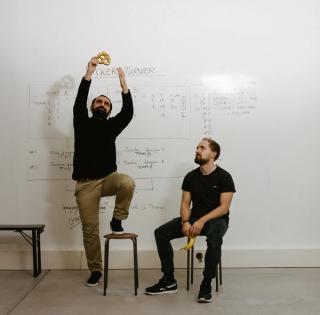

The golden Pretzel—a symbol of a systemized, fluent, and self-contained project workflow as is made possible by the HIIP method.
Design phase completed in just six months—HIIP does it!
The magic triangle of project management:
cost—time—quality. Going jointly for the goal takes experience and know-how.
What, then, is HIIP? Planning by HIIP means segmenting the total planning process into a sequence of shared ‘intensive intervals’ and separated ‘concentrated rest phases.’ Decisions made jointly by all participants—from the definition of objectives throughout the planning stages and to implementation—ensure continuing and efficient project development.
How HIIP is my project? Whether a project is suited for HIIP depends less on the project itself than on the people involved and their willingness to question the familiar and give the new a chance. Experience shows that HIIP is particularly useful for large and complex projects. Facilitating immediate joint decision-making and taking available competencies into account, however, is just as valuable for smaller projects.


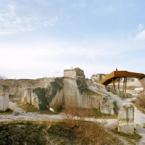
In order to turn visions into reality, coordinated and systematic communication and procedures are needed with everyone involved in the planning. Illustration: Main theme of the project Conversion Gösserhalle, Vienna (AT)
HIIP clients. Participation of clients/ construction owners in the HIIP process requires time and commitment. Active participation offers an opportunity to directly influence the project outcome. Intensive participation also makes proposal, reviewing and approval cycles obsolete. Delays due to multiple or post-processing (repetitive services) are reduced. In the HIIP process, a team is most innovative when it fully understands the needs of others. It is therefore crucial that clients act transparently and reliably in order to benefit, and benefit from, the final result. Commitments must be met, promises kept, and decisions must be made based on the project team’s scheduling requirements. Project management of building owners must have a general understanding of design and construction processes in order to participate in decision-making. Moreover, the role of the client/ construction owner primarily is to provide the best possible support for the performance of the team.
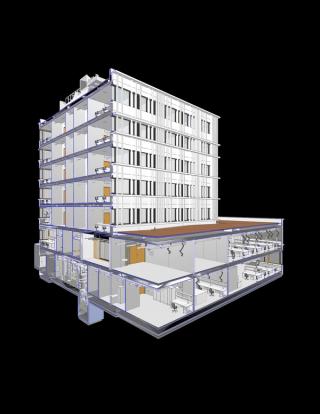
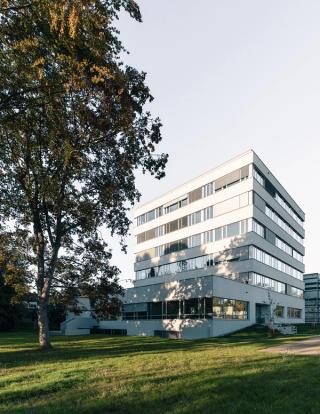
HIIP and BIM. Working toward a shared goal works best when people actually work together on a product. Sounds logical but has in fact no basis in traditional planning. It is only through the use of BIM (Building Information Modeling) and the digital twin it introduces that real-life collaborative work on a project becomes possible. Integrating BIM into planning is therefore a prerequisite for meaningful planning.

HIIP clients know the current project status & progress at any time and have certainty about the outcome long before the project is completed.





AllesWirdGut Architektur ZT GmbH
Untere Donaustrasse 13–15
1020 Vienna, Austria
AllesWirdGut Architektur ZT GmbH
Jahnstrasse 18
80469 Munich, Germany
AllesWirdGut Architektur ZT GmbH
Jahnstrasse 18
80469 Munich, Germany